
You’ve decided an inflatable obstacle course would make your event unforgettable. Now you’re staring at two options—40 ft and 46 ft—and wondering if those extra six feet actually matter.
Spoiler: they do. But not always in the way you’d expect. The difference isn’t just about length—it’s about how the course fits your space, your crowd, and your event goals.
This guide breaks down the real-world differences between 40 ft and 46 ft obstacle courses so you can make the right call for your backyard, field day, or church carnival.
What’s in This Guide
🏡 Backyard Party Planners
You’re planning a birthday or graduation party and need to know if your yard can handle an obstacle course without crowding out the cake table.
🎪 Event Organizers
You’re coordinating a church carnival, corporate field day, or school fundraiser and need to maximize participant throughput without creating chaos.
📐 First-Time Renters
You’ve never rented an inflatable obstacle course before and aren’t sure how to measure your space or what “46 feet” actually looks like in real life.
How Much Space Does Each Obstacle Course Actually Need?
When rental companies list a course as “40 ft,” they’re referencing the run length of the inflatable itself—not the total space you need.
The setup footprint is always larger because you need clearance on all sides for safety, blower placement, and participant flow.
Total Setup Space
45 ft long × 14 ft wide
- Inflatable footprint: 40 ft × 11 ft
- Side clearance: 1.5 ft per side
- Entry/exit zones: 5 ft front and back
- Blower placement area included
Total Setup Space
51 ft long × 16 ft wide
- Inflatable footprint: 46 ft × 12 ft
- Side clearance: 2 ft per side
- Entry/exit zones: 5 ft front and back
- Blower placement area included
💡 Pro Tip: Measure your setup area in the morning when shadows are visible. Walk the perimeter with a tape measure and mark the corners with spray paint or stakes. This gives you a visual sense of how much space the course will actually occupy—and what’s left over for tables, seating, and foot traffic.
What Eats Up Extra Space Beyond the Inflatable
Even if your yard measures 50 feet long, that doesn’t mean a 40 ft course automatically fits. Here’s what consumes the “extra” space:
- Blower positioning: The continuous air blower must sit 3-5 feet from the inflatable intake, connected by a flexible tube. This needs clear ground space.
- Safety zones: Participants sometimes tumble off the side or exit faster than expected. A 1.5-2 ft buffer prevents collisions with fences, trees, or equipment.
- Queue and exit paths: Kids waiting to enter and those who’ve finished need somewhere to stand without blocking the next group.
- Access for setup and teardown: Rental crews need to roll the deflated unit to and from their truck, which means a clear path at least 4 feet wide.

What Do You Actually Get With the Extra 6 Feet?
The difference between a 40 ft and 46 ft inflatable obstacle course isn’t just math—it’s about challenge variety and competitive pacing.
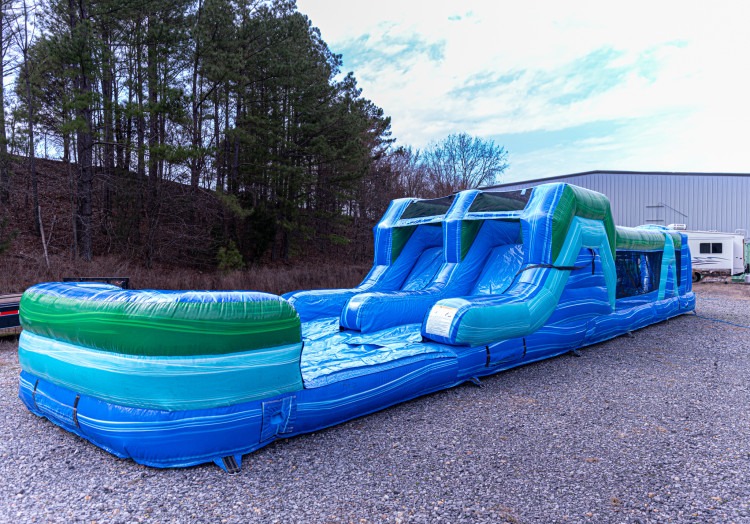
Both courses typically feature dual lanes for head-to-head racing. But the 46 ft version extends the run with an additional obstacle element—often a taller climbing wall, jousting platform, or pop-up barrier sequence.
Typical Obstacle Progression Comparison
40 Ft Course Layout
- Entrance tunnels – low crawl or squeeze-through start
- Pop-up obstacles – inflated pillars to weave around or push through
- Climbing wall – angled ascent, typically 6-8 ft tall
- Slide descent – back-facing or front-facing exit slide
Average completion time: 25–35 seconds for ages 6–12
46 Ft Course Layout
- Entrance tunnels – low crawl or squeeze-through start
- Pop-up obstacles – inflated pillars to weave around or push through
- Climbing wall – angled ascent, typically 6–8 ft tall
- Jousting platform or balance beam – elevated challenge requiring coordination
- Slide descent – back-facing or front-facing exit slide
Average completion time: 35–50 seconds for ages 6–12
That extra obstacle stage isn’t just filler—it changes the competitive dynamic. The longer run creates more opportunities for lead changes, which keeps spectators engaged and participants motivated to race again.
Lane Width: Why It Stays Consistent
Both 40 ft and 46 ft courses maintain similar lane widths—typically 11 to 12 feet for dual-lane racing. This width accommodates participants ages 5 through adult without creating bottlenecks or unsafe crowding.
The lane width doesn’t increase with course length because obstacle courses are designed for side-by-side racing, not group play. Adding width would dilute the competitive structure and make supervision harder.
⚠️ Important: Some rental providers advertise “mega” obstacle courses at 50+ feet. These are often modular units—two separate inflatables connected end-to-end. While impressive, they require significantly more setup space and may not fit typical residential yards. Confirm whether you’re renting a single continuous unit or a multi-piece setup.
Which Obstacle Course Size Works Best for Different Events?
Choosing between a 40 ft and 46 ft obstacle course depends less on the size itself and more on who’s using it, how long your event runs, and what kind of energy you’re trying to create.
Here’s how each option performs across common event types:
🎂 Backyard Birthday Parties
Typical guest count: 10–25 kids Event duration: 2–3 hours
Best choice: 40 ft course
Why: Faster completion time means kids can rotate through multiple times during a 2-hour party. The shorter footprint leaves room for cake tables, seating, and other activities like bounce houses or lawn games. Learn more about mixing activities in our guide to backyard party setup ideas.
🏫 School Field Days
Typical guest count: 50–200+ kids rotating in waves Event duration: 4–6 hours
Best choice: 46 ft course
Why: The extended run time naturally spaces out participants, reducing bottlenecking at the entrance. Older kids (grades 4–6) stay engaged longer because the additional challenge feels less repetitive after multiple runs.
⛪ Church Carnivals & Community Events
Typical guest count: 100–300+ mixed ages Event duration: 3–5 hours
Best choice: 46 ft course (with age group scheduling)
Why: The extra obstacle elements accommodate broader age ranges—from elementary kids to teens and even adults. The longer course also creates a more impressive visual centerpiece for large outdoor gatherings.
🏢 Corporate Team-Building Events
Typical guest count: 30–100 adults Event duration: 2–4 hours
Best choice: 46 ft course (adult-rated)
Why: Adults appreciate the extra challenge and the longer run justifies the “silly factor” of participating. Timed heats create natural brackets for competitive tournaments. Ensure your rental unit is commercial-grade and rated for adult weights.
🎓 Graduation Parties
Typical guest count: 20–50 mixed ages (teens + adults) Event duration: 3–4 hours
Best choice: 40 ft or 46 ft (depends on yard size)
Why: Either works well for grad parties since participation is voluntary. If your yard is tight and you want to include other entertainment like additional party activities, the 40 ft version preserves space. If the obstacle course is the main attraction, go with 46 ft for bigger impact.
🏀 Sports Team Celebrations
Typical guest count: 15–40 kids (single team + families) Event duration: 2–3 hours
Best choice: 40 ft course
Why: Faster rotations keep the energy high and prevent downtime. Team-oriented kids thrive on quick head-to-head races with multiple chances to improve their times. The compact footprint works well in park pavilion areas or smaller backyards.
Does Grass vs Pavement Change Which Size You Should Choose?
Surface type doesn’t change the footprint requirements, but it does affect setup logistics, safety, and participant comfort—all of which can influence your size decision.
Grass Setup Considerations
Grass is the preferred surface for inflatable obstacle courses. Here’s what changes when you set up on turf:
- Anchoring method: Rental crews drive 12–18 inch stakes through anchor loops at the base of the inflatable. This creates a more secure hold than sandbags and allows the course to handle higher winds safely.
- Cooler surface temp: Grass stays significantly cooler than pavement in summer heat, which matters for barefoot or sock-wearing participants sliding down exit chutes.
- Softer landing zones: If a participant tumbles off the side (rare but possible), grass provides better cushioning than concrete or asphalt.
- Drainage: If rain threatens your event, grass absorbs water better than pavement. A slight dampness won’t make the inflatable unsafe, but pooling water on pavement can create slipping hazards around entry/exit points.
💡 Pro Tip: If your event is during peak summer heat, positioning the obstacle course so the slide exit faces away from direct afternoon sun makes a noticeable difference in participant comfort. The slide surface can get warm even on grass—shade or strategic positioning helps.
Pavement and Concrete Setup Considerations
Setting up an inflatable obstacle course on pavement or concrete is absolutely doable—rental companies do it all the time for parking lot carnivals, street festivals, and school blacktop events. Here’s what changes:
- Sandbag anchoring: Instead of stakes, crews use heavy sandbags (typically 25–40 lbs each) secured to anchor points. This requires more prep time and increases the number of sandbags needed for a 46 ft course versus a 40 ft course.
- Surface heat: Asphalt and concrete absorb and radiate heat. On 90°F+ days, pavement surface temps can reach 120–140°F, making barefoot play uncomfortable and increasing the need for shaded waiting areas.
- Abrasion risk: Pavement is harder on the inflatable material than grass. Reputable rental companies use protective tarps under high-friction zones, but rougher surfaces increase wear over time.
- Noise and vibration: Hard surfaces amplify blower noise slightly and create more bounce/vibration as participants move through the course. Not a dealbreaker, but noticeable in enclosed areas like covered pavilions.
⚠️ Surface Rule: If your pavement has loose gravel, significant cracks, or drainage grates, notify your rental company in advance. They may need additional tarps or ask you to sweep the area before setup. Sharp debris can puncture inflatable seams, and uneven surfaces affect stability.
Does surface type change which size course you should rent? Not directly—but if you’re setting up on pavement in summer heat and your event runs 4+ hours, the faster rotation of a 40 ft course might reduce heat fatigue compared to a longer 46 ft run. For spring, fall, or shaded pavement areas, surface type is a non-factor in sizing decisions.
How Many Kids Can Actually Use Each Course During Your Event?
Obstacle course “capacity” isn’t about how many people can physically fit inside—it’s about throughput: how many participants can complete runs during your event window without excessive wait times.
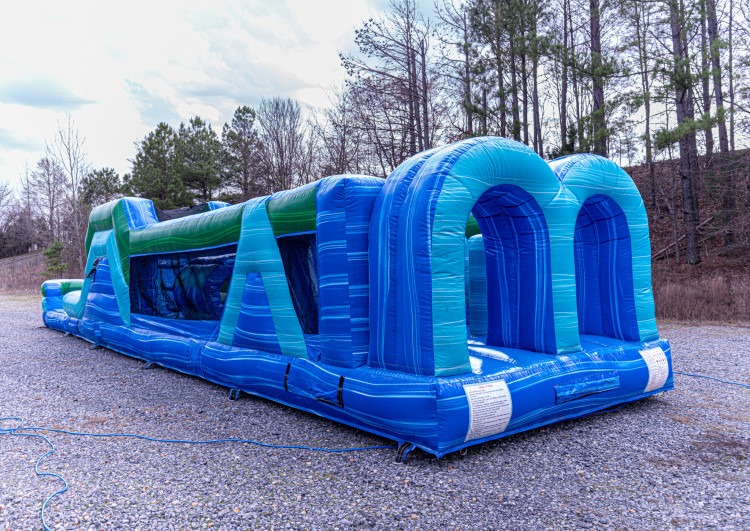
Both 40 ft and 46 ft courses accommodate 2 simultaneous racers (dual-lane design). The difference in run length affects how quickly you can rotate new participants in.
Realistic Throughput Comparison
40 Ft Course Throughput
Average run time: 30 seconds
Reset time: 15 seconds (participants exit, new racers enter)
Total cycle: ~45 seconds
Runs per hour: ~80 (2 participants × ~40 cycles)
During a 2-hour party, you can cycle approximately 160 total runs—meaning 20 kids could each race 8 times with minimal wait.
46 Ft Course Throughput
Average run time: 45 seconds
Reset time: 15 seconds (participants exit, new racers enter)
Total cycle: ~60 seconds
Runs per hour: ~60 (2 participants × ~30 cycles)
During a 2-hour party, you can cycle approximately 120 total runs—meaning 20 kids could each race 6 times with minimal wait.
The 40 ft course offers slightly faster turnover, which matters for shorter events or younger kids with shorter attention spans. The 46 ft course naturally creates longer engagement per turn, which works better for older participants or all-day events where maximizing individual playtime matters more than raw throughput.
What Actually Slows Down Participant Flow
Run time isn’t the only variable that affects throughput. Here are the real-world factors that create bottlenecks:
- Shoes-on vs barefoot rules: If participants need to remove shoes before entering, add 10–15 seconds per rotation for shoe removal and re-application. Grip socks are the compromise solution.
- Age mixing: Younger kids (5–7) take 1.5–2× longer to complete the same course as older kids (10–12). If you’re running mixed-age heats, throughput drops significantly.
- Supervision gaps: Without a designated adult managing the queue and calling “next racers,” kids naturally cluster at the entrance or wander off, creating uneven flow.
- Photo/video pauses: Parents stopping to film or photograph their child adds 5–10 seconds per heat. Designate a “photo zone” away from the entrance to keep flow moving.
- Re-inflation delays: If multiple heavy participants exit simultaneously or someone accidentally unplugs the blower, the unit may sag slightly and need 30–60 seconds to fully re-inflate. Rare, but it happens.
💡 Flow Optimization Tip: Assign one adult as “course marshal” to manage the queue, call heats, and enforce safety rules. This single role can increase throughput by 20–30% compared to unsupervised free-for-all play. For more on managing participant safety, see our bounce house safety tips—the same principles apply to obstacle courses.
How to Measure Your Space Before You Commit
Don’t rely on guesswork or pacing off the area. Here’s the process rental pros recommend to confirm a course will actually fit:
- Measure the full run length: Use a tape measure or smartphone measurement app to confirm you have at least 50 ft of unobstructed length for a 40 ft course, or 55 ft for a 46 ft course. Mark each end with chalk or a small flag.
- Measure the width: Confirm at least 16 ft of width (18 ft is better). Check for overhead obstructions like low-hanging tree branches, pergola beams, or power lines—most obstacle courses have peak heights of 10–12 ft.
- Identify obstacles within the footprint: Sprinkler heads, landscape lighting, decorative rocks, or garden borders need to be temporarily removed or protected. Rental crews can work around some obstacles, but too many complications may disqualify the space.
- Check access paths: The delivery crew needs to roll the deflated inflatable from their truck to the setup area. Confirm a 4 ft wide path exists through gates, along the side of your house, or across the lawn. Crews can navigate tight spaces, but advance notice helps.
- Locate the power source: Obstacle course blowers require a standard 110V outlet within 50–75 ft of the setup location. Extension cords work, but the outlet must be on a dedicated 15–20 amp circuit (not shared with appliances like refrigerators or AC units).
- Photograph the space: Take wide-angle photos from multiple angles and text them to your rental company when you request a quote. This helps them confirm feasibility and spot potential issues you might miss.
🚩 Non-Negotiable Space Rule: If your usable area is less than 50 ft long or 14 ft wide, an obstacle course won’t work safely—even a 40 ft unit. Don’t try to squeeze it in. Instead, explore alternatives like smaller interactive inflatables, water slides, or bounce house combos that fit tighter spaces.
What Rental Companies Need to Know When You Request a Quote
When you contact a rental provider to compare 40 ft vs 46 ft obstacle course options, providing specific details upfront gets you accurate pricing and availability faster.
Here’s what rental companies need to confirm feasibility and provide a realistic quote:
📅 Event Details
- Event date and start time
- Rental duration (hours)
- Event type (birthday, carnival, field day, etc.)
- Estimated participant count and age range
📍 Location Information
- Full address (city/county matters for delivery fees)
- Setup location (backyard, park, parking lot, etc.)
- Surface type (grass, pavement, gravel, artificial turf)
- Access path constraints (narrow gates, stairs, etc.)
📐 Space Measurements
- Length and width of setup area
- Overhead clearance (tree branches, pergolas, etc.)
- Distance from power outlet to setup spot
- Photos of the space (wide-angle preferred)
Most reputable rental companies will ask follow-up questions about slope, drainage, and nearby hazards. This isn’t them being picky—it’s them ensuring a safe, successful setup that meets insurance and safety standards. For more planning guidance, explore our summer party planning checklist.
Frequently Asked Questions
How much space does a 40 ft inflatable obstacle course need?+
A 40 ft obstacle course typically requires a setup area of approximately 45 ft long by 14 ft wide. This includes the inflatable itself plus safety clearance on all sides. You’ll also need about 6–8 feet of clearance at the entrance and exit for safe participant flow.
What’s the difference between a 40 ft and 46 ft obstacle course?+
The primary difference is run length and challenge variety. A 46 ft course adds approximately one additional obstacle element, typically an extended climbing wall or jousting platform. The lane width remains similar (typically 11–12 ft), but the extra 6 feet of length creates more competitive racing dynamics and increased participant engagement time.
Can you set up an inflatable obstacle course on pavement?+
Yes, most commercial-grade inflatable obstacle courses can be set up on pavement using sandbag anchoring systems instead of stakes. However, grass is preferred because it provides better cushioning, cooler surface temperatures in summer heat, and easier stake anchoring. Pavement setups require additional sandbags and careful positioning to ensure stability.
How many kids can use an inflatable obstacle course at once?+
Most dual-lane obstacle courses accommodate 2 participants racing simultaneously, with 2–4 additional participants waiting in the queue area. For continuous event flow, plan for groups of 4–6 kids rotating through. Total capacity depends on supervision, age groups, and whether you’re running timed heats or continuous play.
Will a 46 ft obstacle course fit in a standard backyard?+
A 46 ft obstacle course needs approximately 50–52 ft of usable length and 16–18 ft of width including safety zones. Many suburban backyards in DeSoto County range from 60–80 ft deep, making a 46 ft course feasible if positioned lengthwise. However, you must account for fence lines, trees, AC units, and access paths for setup and teardown.
What’s better for a church carnival—40 ft or 46 ft obstacle course?+
For church carnivals with mixed age groups and high participant volume, a 46 ft obstacle course often works better because the extended run time creates natural spacing between participants and reduces bottlenecking. The additional obstacle elements also keep older kids and teens engaged. However, if your event space is limited or you’re serving primarily younger children (under 8), a 40 ft course may provide better throughput and less intimidation.
Making the Right Choice for Your Event
The decision between a 40 ft and 46 ft inflatable obstacle course comes down to three core factors: available space, participant age range, and event duration.
If you’re working with a compact backyard, hosting younger kids (under 8), or running a shorter 2–3 hour party, the 40 ft course delivers faster rotations and easier space management. If you have room to spare, mixed age groups, or an all-day event like a field day or carnival, the 46 ft course creates more engagement per run and reduces queue congestion.
Neither option is inherently “better”—they’re designed for different scenarios. Measure your space carefully, think through your participant flow, and communicate those details to your rental provider. They can help you confirm which option actually fits your setup and matches your event goals.
For more ideas on creating memorable events, explore our guides to memorable kids’ party ideas and party entertainment options. And if you’re planning ahead, check out common party setup mistakes to avoid logistical headaches on event day.
Ready to See Your Options?
Browse our full selection of obstacle courses and interactive inflatables to find the perfect fit for your event. No pressure, no sales pitch—just clear info on what’s available and how it works.
Browse RentalsQuestions? Call (901) 235-3474 or visit our obstacle courses category for detailed specs and availability.